Free Quote
Cognize Meeting Cognize Meeting

FAQ

Frequently asked questions about the digitalization of B2B trade

We've gathered the most common questions asked during conversations with companies considering implementing a B2B e-commerce platform . If you don't find the answers you need here, please contact us.


How much does a Pre-Implementation Analysis cost?

The cost of the analysis is closely related to the complexity of the planned project and the number of areas that must be precisely described (e.g., the number of integrations, the sophistication of the pricing policy, order workflow). We determine the exact amount during the Cost Forecast preparation stage, after initially reviewing your needs.

Typically, this process ranges from PLN 12,400 to PLN 24,500 net, with two main variants:

• Simplified analysis (approx. PLN 12,400 net) – dedicated to smaller-scale projects in which business processes are already well defined and only require translation into system architecture.
• Full pre-implementation analysis (approx. PLN 24,500 net) – essential in the case of multi-channel, multi-lingual systems with an extensive pricing policy (e.g. individual price lists for groups of contractors) and numerous external integrations.

The analysis results (backlog, technical specifications, cost estimates, architecture development, etc.) become your property. The documentation is prepared so that after its completion, you can request a quote from any vendor on the market. The analysis is your most important safeguard – it eliminates the risk of project underestimation and protects you from vendor lock-in.

How precise is the cost forecast before the Pre-Implementation Analysis? What percentage margin should I assume?

The cost forecast we prepare at the sales stage is the best estimate based on available information. After analysis, the valuation becomes much more precise. We recommend a margin of 15–20% – not because we estimate incorrectly, but because during the analysis new needs or clarifications regularly emerge that were not included in the initial brief.

We've had projects where the scope has shrunk and the pricing has dropped. But more often than not, we've grown with the client because the analysis has uncovered opportunities we hadn't even discussed initially, which is often the result of engaging a broader client committee in the analysis process.

How much time does my team need to devote to Pre-Implementation Analysis?

The entire analysis process usually takes from 3 to 4 weeksIt's designed to maximize your team's time without compromising their ongoing work.

The structure of engagement is as follows:

• Opening workshop: One full working day (in-person or online) during which we define the project foundations, business processes and key goals.
• Thematic sessions: A series of 3–4 video calls (approx. 2 hours each), focused on specific areas (e.g. ERP integration, pricing policy, logistics).
• Consultant's own work: Between meetings, our analyst and tech lead document findings, design the architecture, prioritize stages, and prepare the backlog. Meanwhile, you complete your tasks, returning to us only with answers to clarifying questions.

Who do we engage? We respect your management team's time. During workshops, we usually need 2–3 people (Business Leader + person from the IT department/E-commerce(salespeople) who have real knowledge of the processes. There's no need to involve the entire management board in every meeting – their presence is crucial only at the start and when summarizing the results. In total, your team involved in the Analysis will spend approximately 16 hours on meetings.

How can I be sure that what I need is included in the cost forecast?

Our cost estimate is a process, not a one-sided document. Before you receive it, we go through specific verification steps:

1. Needs identification and technical meeting: Before we provide a quote, we meet with you for a technical session led by our consultant. We analyze your company's current processes and how they will evolve in the future. The assessment process is conducted by our lead consultant, who, as a former B2B consultant, E-commerce The manager himself was once "on the other side of the table." This allows us to avoid guesswork.
2. Discussing the forecast before the offer:We don't send you a blind quote. We discuss the prepared cost forecast with you before submitting a formal offer for a pre-implementation analysis. We do this to jointly verify that the needs we've identified fully align with the reality of your business.
3. Consultant's comment: Each item in the quote is accompanied by a comment from the consultant, highlighting the assumptions made and areas requiring further clarification.
4. Full transparency: If something remains unclear at this stage, we mark it as "unknown to be determined during analysis." We don't hide risks in small print—we name them directly.

Remember that a pre-implementation forecast is a reliable estimate based on available data. Only the Pre-Implementation Analysis will allow us to transform this estimate into a precise fixed-price offer or a precise backlog for the time and materials model.

What does the project valuation process look like?

We don't send a single, final price at the outset—the accuracy of our pricing increases as we learn more about each other. We divide it into three stages:

1. First Meeting - Order of Magnitude
Based on what you tell us about your company (sales volume, number of SKUs, current system, key challenges), we can immediately provide an indicative range within which the project will most likely fit—for example, "tens of thousands of zlotys" or "closer to the upper end of that range rather than the lower." This isn't an offer or a commitment—it's a benchmark to help you assess whether it's even worth proceeding before investing time in further discussions. We're deliberately avoiding narrow ranges here—an overly precise number at this stage would be a guess, not a valuation, and is more likely to be misleading than helpful.

2nd Technical Meeting - Cost Forecast
After we sit down with your team to discuss specific processes (integrations, pricing, order workflow, required functionalities), we prepare a Cost Forecast—a document with a specific amount, broken down into functional blocks, so you can decide what to implement immediately and what to leave for later. Each item is commented on by the consultant with assumptions, and anything we can't yet precisely assess is explicitly marked as "to be further clarified during the Analysis." Historically, this forecast matches the final contract scope to within 15-20%. To be fair: sometimes this amount fluctuates more than 15-20%—usually because the client's team hasn't yet clarified all their requirements (e.g., the scale of multilingualism, the number of integrations). This is normal—that's where the next step begins.
3. Pre-Implementation Analysis - binding amount
Only a full analysis (3–4 weeks, workshops + topical sessions) provides a fully defined backlog, architecture, and schedule—and, based on this, a binding amount, which you sign as a contract. This document becomes your property, regardless of whether you choose to work with us or with someone else.

We have customers who shop online and in-store. Can we manage pricing for all of them from one place?

Yes – this is one of the most common scenarios that we implement using our dedicated Price ApplicationIt allows for full unification of pricing policy for all sales channels: online and offline.

Thanks to it, you can assign discount groups, individual conditions per contractor, margins or progressive quantity thresholds, and the system will ensure their consistency regardless of the place of purchase.

Key features of our approach:

• The app as a single source of truth: Unlike many standard solutions, our base configuration doesn't have to come from an ERP system. The Pricing app can be the single, definitive place where you define your company's pricing policy.
• Offline pricing as standard: We treat prices for traditional (brick-and-mortar) channels as another, equal type of price. This means your in-store salesperson and online customer operate on the same, precisely calculated data.
• Efficiency and latency: Even when integrating with an ERP, the Pricing App calculates value in near real-time. This solves the critical problem of "ERP polling," which often creates delays that prevent a seamless customer experience.

Where does the price list configuration come from – from ERP or from the store system?

The choice of source of truth for price lists depends on the complexity of your trading policy. We use two approaches in our implementations:

1. ERP as the single source of truth: If your pricing policy isn't very advanced (e.g., based on a few discount groups and fixed price lists assigned to customers), this model is fully sufficient and optimal. In this setup, the Sellina platform pulls data directly from the ERP system, which manages the entire logic. This solution is simple to maintain and effective for companies with established discount structures.
2. Price Application: In the case of highly complex processes (e.g. thousands of individual prices per SKU, overlapping time-based promotions, quantity thresholds, or the need to quickly recalculate prices for multiple sales channels), we suggest implementing our Price Application.

• In this variant, the Pricing Application becomes the "brains" of the operation. It can retrieve base data from the ERP, but performs all calculation logic in-house.
• This solves the efficiency problem (ERP often takes too long to return the individual price) and allows for flexible management of promotions that the old ERP system might not be able to handle without costly rework.

Regardless of the model you choose, our goal is to ensure that the customer sees the correct price in the basket in a fraction of a second and your sales team has full control over the margin.

After connecting email, won't the CRM be flooded with emails?

No, if integration is preceded by establishing rules. The value of integration is determined by the input filter, not the actual message retrieval itself: CRM receives sales correspondence related to specific customers, not the entire contents of inboxes. We establish rules before launch, so from day one, the system is filled with signal, not noise.

How does CRM know which customer to assign an email to?

Messages are mapped based on the sender's email address to the contact information stored in the customer's record. This also works when the initial contact arrives in the general inbox and the salesperson takes over the conversation from their individual inbox: both messages are transferred to the same customer's history. Emails from addresses that cannot be linked to any contact are not assigned anywhere.

We have multiple stores, general and individual mailboxes. Will we be able to see all customer communications in one place?

Yes, that's the main reason for this integration. Conversation history is visible on the customer's card, regardless of which mailbox the message originated from, so the account manager can also see correspondence previously exchanged with someone else. With multiple stores and multiple mailboxes, this is the only way to fully understand the customer's context before the conversation.

Will employee private emails be sent to CRM?

No. Only messages that can be associated with an identified sales contact enter the system, while personal and non-customer correspondence remains outside of the CRM. The scope of messages downloaded is explicitly agreed upon with the team before the integration launches, so everyone knows what is being synchronized.

Who decides which emails are important and should be sent to CRM?

You, because this is a business decision, not a technical one. The team determines the types of messages that should be sent to the CRM and the rules that should apply, and we translate these decisions into the integration configuration. What we won't do: we won't determine for you which messages have commercial value, as this knowledge is available only to the team working with clients.

Michal Kozik

Have any questions?

Let's talk about cooperation.

Contact us

What do our clients say about us?

★★★★★

Punctuality, flexibility, availability, professionalism (...)

In 2017, we began working with Cognize (KMK Group) on the BAST system. Since then, the project has been developed and managed with exemplary skill. Cognize's (KMK Group) work is characterized by timeliness, flexibility, availability, professionalism, and, most importantly, the ability to present complex programming solutions in an accessible format.

Zbigniew Mastek
President of the Management Board of Inter Elektro

★★★★★

This cooperation has resulted in our development and stability.

This cooperation has resulted in our development and stability, and the form of business contacts based on mutual trust is increasingly rare today, yet extremely effective.

Roman Ostrowski
Chairman of the Board
Ostrowski Online Trading

★★★★★

(…) we can now easily and effectively manage our product catalog (…)

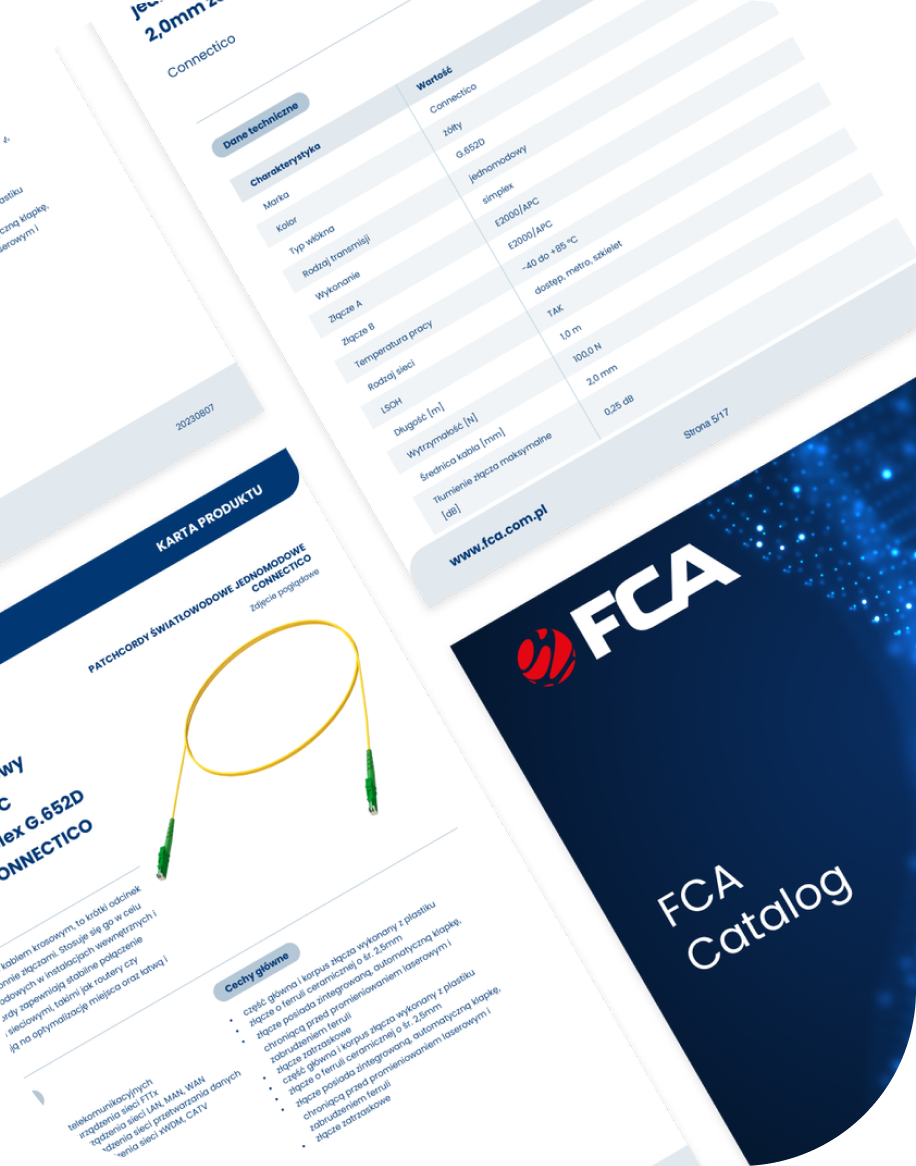
Cognize provided us with two services: Digital Sales Transformation Consulting and PIM Implementation. They provided the necessary know-how and demonstrated methods for various business process integrations with PIM systems. Thanks to their expertise, we can now easily and effectively manage our product catalog while minimizing implementation costs.

Maciej Sanocki
Global Sales Specialist
B2B and PIM Implementation Manager at FCA SA

★★★★★

They helped us understand our needs and proposed the best solution based on the analysis results.

Our collaboration with Cognize began with a consultation. At this stage, they helped us understand our needs and proposed the best solution based on the analysis results. Cognize then began implementing the final system. The project was conducted with a high level of communication, on time, and, most importantly, with the Cognize team's ongoing initiative.

Executive director
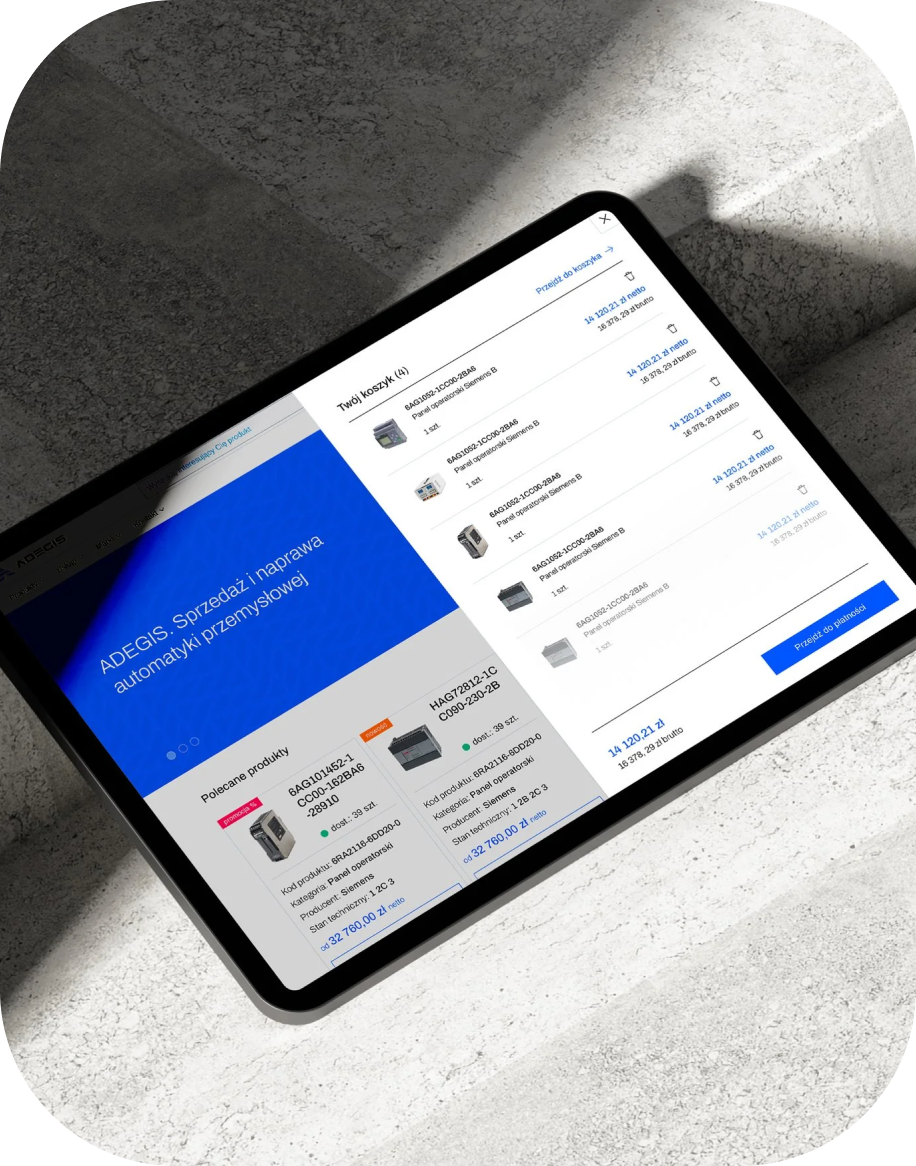
ADEGIS Sp. z o.o. Sp. k.

★★★★★

Immediately after opening the new store, we saw an immediate increase in sales.

After launching the new online store, sales immediately increased. The Cognize team (formerly KMK Group) was able to manage the project independently, working with minimal involvement from the snowboard brand. Their independence and communication skills were also impressive.

Leszek Kindrat
Owner of the KOSMOS company

★★★★★

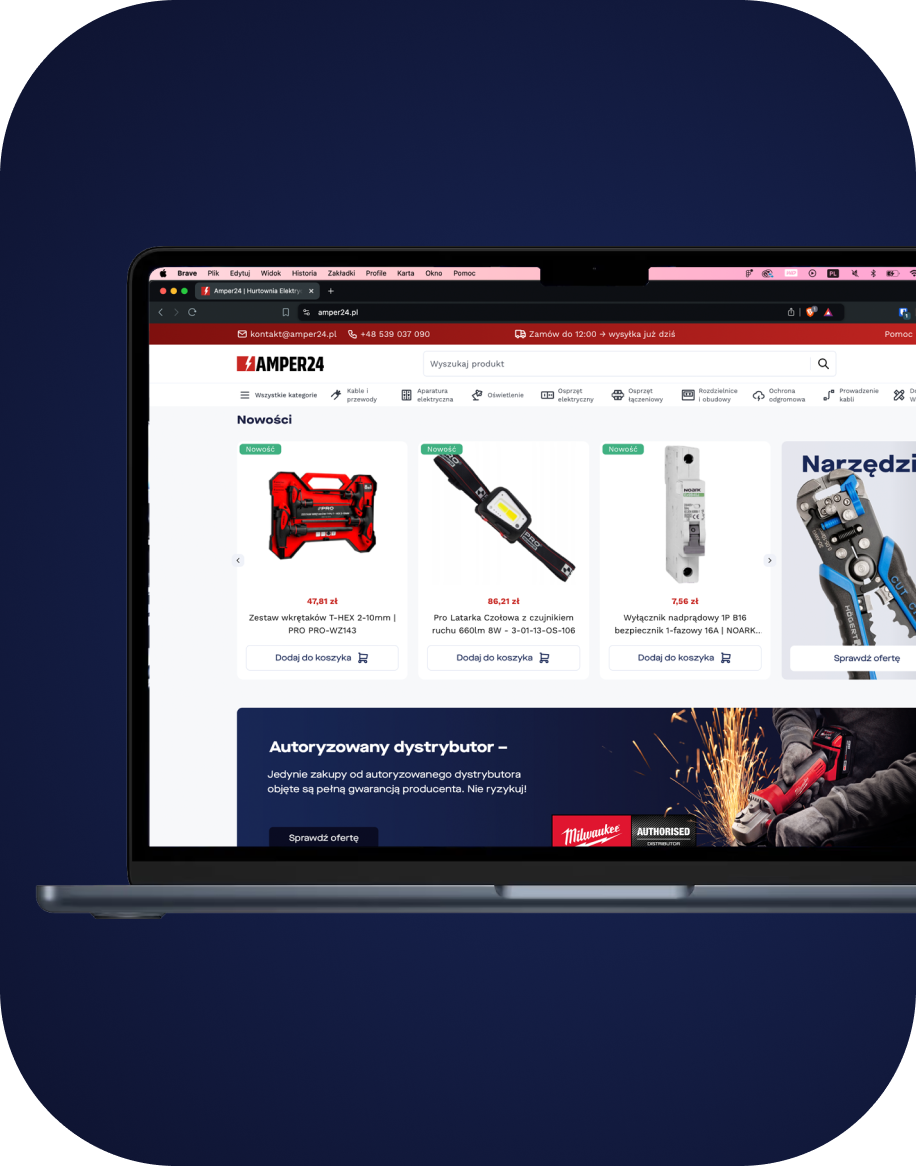
(...) we recorded a dynamic increase in our company's turnover

(...) The e-commerce platform they created not only meets all our expectations but also provides enormous opportunities for future technological development. Thanks to the solid technical architecture and innovative features, we have seen dynamic growth in our company's turnover, which we attribute directly to the functionality of the new website. Excellent communication and high availability of the team ensured we could count on support at every stage of the project. (...)

Marek Opala
Amper24.pl

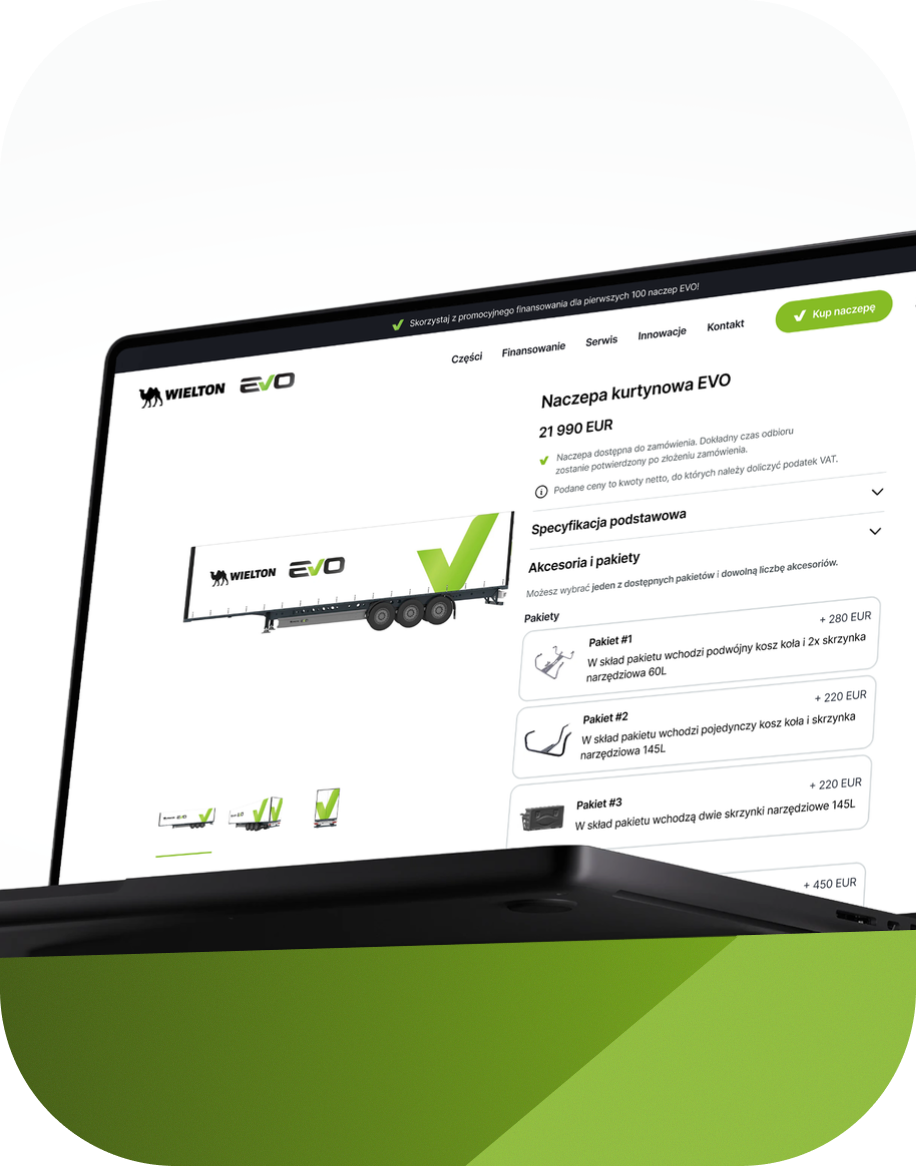
Discover our selected projects

See all case studies
Do you have an idea, a ready specification or a business need?

Write to us. We will contact you within 24 hours.
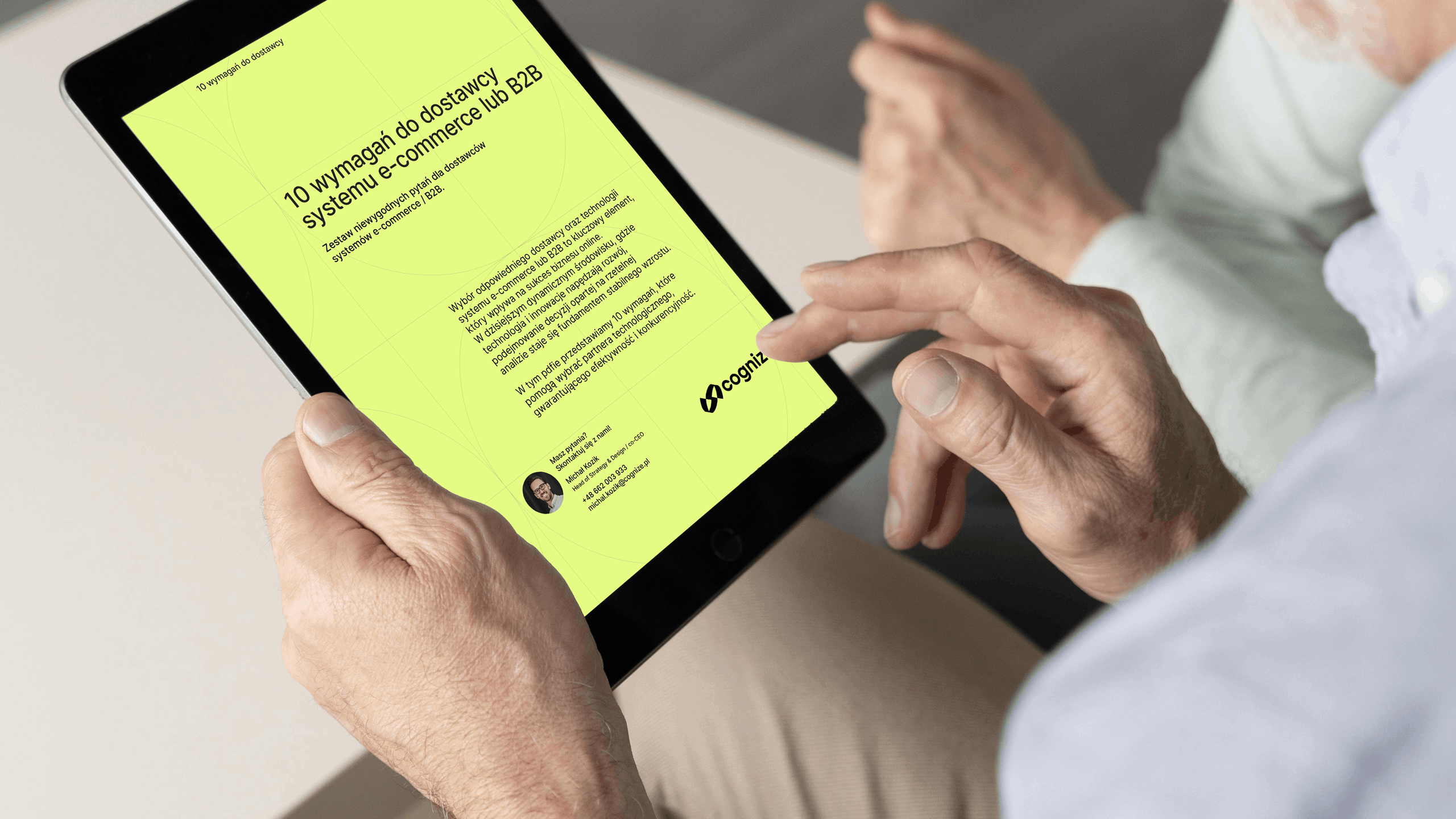
go to the page - download 10 requirements for a b2b e-commerce provider

Free PDF

Before you choose eCommerce B2B/B2C,
read this!

Download our free guide: 
"10 Questions to Ask an eCommerce or B2B System Provider".
Thanks to it, you will make sure that you have not missed anything, saving time and money.