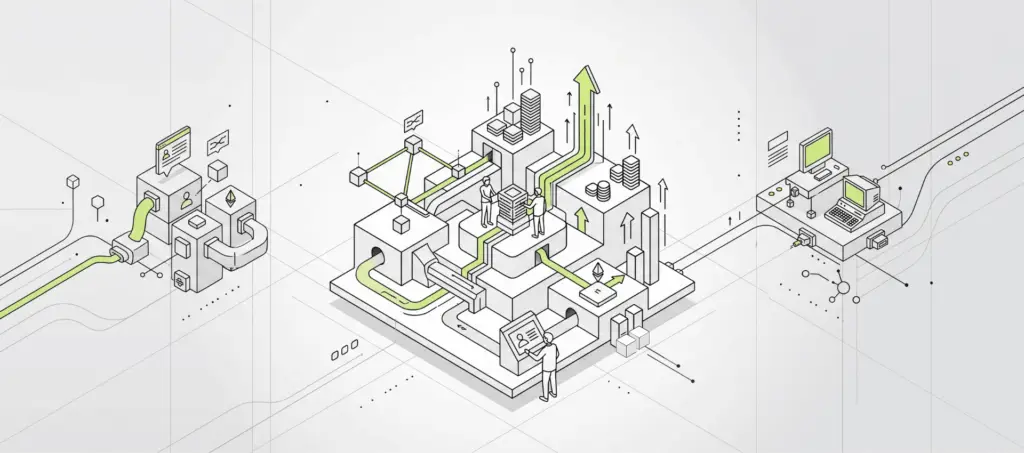
Implementing e-commerce in a manufacturing company is a complex process, but increasingly essential to meeting customer expectations and increasing market competitiveness. Manufacturing, which until recently relied primarily on a B2B model and traditional distribution channels, is increasingly opening up to online sales. In this guide, we present the key steps, challenges, and tools that help you effectively plan and implement e-commerce in a manufacturing environment.
Why do manufacturing companies decide to implement e-commerce?
The digitalization of sales processes is becoming an essential element of the development strategies of many manufacturing companies. The introduction of online channels allows not only for expanding reach and reaching new customer groups, but also for the automation of sales processes.
Key benefits of implementation e-commerce in a manufacturing company:
- Enabling online sales to various customer groups (B2B and B2C),
- Better control over inventory and orders,
- Building a positive user experience on the website (UX),
- Reducing order processing time thanks to process automation,
- Possibility of expansion into foreign markets.
Thanks to e-commerce Manufacturing companies can respond more quickly to changes in demand and customer expectations, which translates into increased sales and competitiveness.
How to prepare for implementation e-commerce in a manufacturing company?
Preparing to implement an e-commerce platform requires thorough analysis and planning. A key element is analyzing current sales processes and integration with IT systems.
Preparation steps:
- conducting data analysis and user behavior,
- defining the strategy e-commerce tailored to the specific production and customer groups,
- preparing integration with the ERP system and warehouse management tools,
- choosing the right sales model,
- defining the product range and the method of presenting product information.
It is also worth planning marketing activities and preparing to optimize activities in e-commerce based on data from tools such as Google Analytics.

What challenges do manufacturing companies face when implementing e-commerce?
Manufacturing companies often encounter specific challenges related to the nature of their business.
Most common problems:
- Complexity of the assortment and its variants (configurators, non-standard products).
- Integration with warehouse and ERP systems.
- Managing prices and discounts for different customer groups.
- Extended production time and customer expectations regarding delivery.
- Maintaining sales continuity despite dynamic changes in inventory levels.
The solution to these problems is to use an appropriate platform that enables process personalization and integration with the existing IT infrastructure.
What technologies and tools are necessary in e-commerce for manufacturing companies?
Implementing e-commerce in a manufacturing company requires the use of technologies that support sales management, integration with production processes and building customer relationships.
Necessary tools:
- platform e-commerce with B2B and B2C functions,
- PIM system for managing product information,
- ERP for synchronizing warehouse data, prices and production statuses,
- tools that automate sales processes (e.g. Baselinker),
- payment and delivery systems tailored to different markets,
- data analysis and optimization solutions (Google Analytics, Google Ads).
It is crucial to ensure integration with the ERP system and automation of sales and logistics processes – thanks to automation, costs can be significantly reduced and order fulfillment times shortened.

What platforms e-commerce work best in manufacturing companies?
Choosing the right platform e-commerce in a production environment, it should take into account, among others, the specificity of the product range, complex ordering processes, integration with ERP and the need to differentiate the offer for different customer groups.
Magento is particularly well-suited for manufacturing companies – a platform with a high level of flexibility and scalability. Magento enables advanced offer personalization, sales process automation, and easy integration with external systems such as ERP, PIM, and OMS.
It works on the basis of Magento Sellina
- solution e-commerce Designed with the needs of the B2B sector in mind, Sellina perfectly meets the requirements of companies with:
- extensive product catalog,
- varied prices and discounts for many customer groups,
- the need to automate sales processes and order management,
- the need for integration with ERP and PIM systems.
Sellina offers full control over product presentation, flexible pricing mechanisms, and efficient management of purchasing processes and distribution – making it an ideal platform for manufacturing companies looking to effectively develop online sales in a B2B/B2C model. When considering implementing a platform, it's worth basing your choice not only on functionalities but also on the sales strategy and operational sophistication of the company. If you're unsure which platform is right for your company, it's worth analyzing the strategy. e-commerce with experienced advisors.

Implementation e-commerce in a manufacturing company – summary
Implementing e-commerce in a manufacturing company is a process that requires precise planning, appropriate strategy, and technology selection. Digital sales transformation allows for increased competitiveness, reaching new customer groups, and optimizing sales and production processes.
If your company is considering implementing an e-commerce platform , it's worth exploring the available options and seeking expert assistance. We support companies in designing and implementing comprehensive B2B and B2C e-commerce system implementations , as well as integrating with ERP and PIM systems.