The problem is that the answer, "AI is safe" or "AI is unsafe," means nothing, as it depends on the version of the tool you're using and how the entire process is designed. In this article, we break it down: what the difference is between a free and a commercial plan, what the GDPR actually says about AI, and what it looks like in practice when implementing automation or micro-applications directly in your company.
Commercial Plan vs. Free Plan – The Key Difference
The biggest misconception in conversations about AI security is that people only know AI from the free version—the one they use privately on their own accounts. And that's what they base their opinions on the entire technology on.
When working with clients, we exclusively use commercial plans (in our case: Claude Team from Anthropic). This distinction has specific consequences. According to the commercial terms of such a plan, the model provider does not train the AI on customer data—neither what we enter nor what the model responds to. Documents, code, quotes—none of this feeds into a model used by anyone else, including competitors.
The second element is data retention. With the commercial plan, data is stored on servers in an encrypted format (AES-256) for a limited time—30 days—after which it is permanently deleted. This isn't an archive someone can return to a year later.
So, if the question arises, "Will AI remember our data and pass it on?" in the free plan, the answer is often "yes, to some extent." In the commercial plan we use – Cognize – the answer is no, because the commercial agreement precludes this.
Do our automations and AI agents scan everything in the background?
The second type of concern concerns not the AI model itself, but the automation processes we build on it—for example, in n8n or in developer tools. The client's question is usually: does this automation have continuous access to our database or email inbox?
No. Neither n8n nor the tools we use (e.g., Claude Code) scan databases or computers in the background. Only the data and files we precisely specify as input for a specific task are sent to the model. If automation is to prepare a response to a request for quotation, the model receives the content of that single request—not the entire inbox, not the entire customer database.
All communication between systems is encrypted (TLS 1.2+). In practice, this works on the same principle as other secure integrations your company already uses – the difference lies in what specifically enters the model, and this is always precisely defined at the process design stage.
GDPR, certificates and legal basis
If your company's legal department is approached with AI topics, you'll likely be asked about certifications and the legal basis for data processing. These are specific, verifiable issues.
Anthropic (the supplier of the Claude model we use) has SOC 2 Type II and ISO 27001:2022 certificates, and additionally ISO 42001 – a certificate dedicated to AI systems management, which only a few suppliers on the market still have.
A signed data processing agreement (DPA) applies to GDPR, and data transfer to the US is based on the Standard Contractual Clauses (SCCs) embedded therein. Additionally, Anthropic declares its participation in the EU-US Data Privacy Framework as an alternative basis for transfer, but it's worth verifying its current status on dataprivacyframework.gov. Formally, this means that legally, we (Cognize) act as your processor, legally entrusting data to a certified sub-processor (Anthropic). The entire processing chain is based on strict, proven principles—exactly the same ones you expect from your trusted cloud providers.
Customer Implementations: Who Has Access to Your Data?
A separate category of questions applies when we're building a micro-application or automation for you (e.g., in n8n or Lovable) that will run directly within your company, connected to your accounts. Here, the client's question is usually most specific: "Is it safe for your automation to touch our systems?"
This is, in practice, the most secure collaboration model because you retain full control and ownership of your data—not us. It works like this:
The infrastructure is yours. Automation scenarios, databases, and micro-application code—we deploy everything in your environment or on your independent company accounts. Data circulates exclusively within your ecosystem. Cognize designs and implements the system, but once it's delivered, we have no insight into the processed information.
API keys operate under your commercial terms. When we connect official, proprietary API keys (e.g., Anthropic or OpenAI) to your account for automation, you're automatically covered by the same commercial protections we mentioned above—a ban on training your model on your data and automatic deletion of your query history after 30 days.
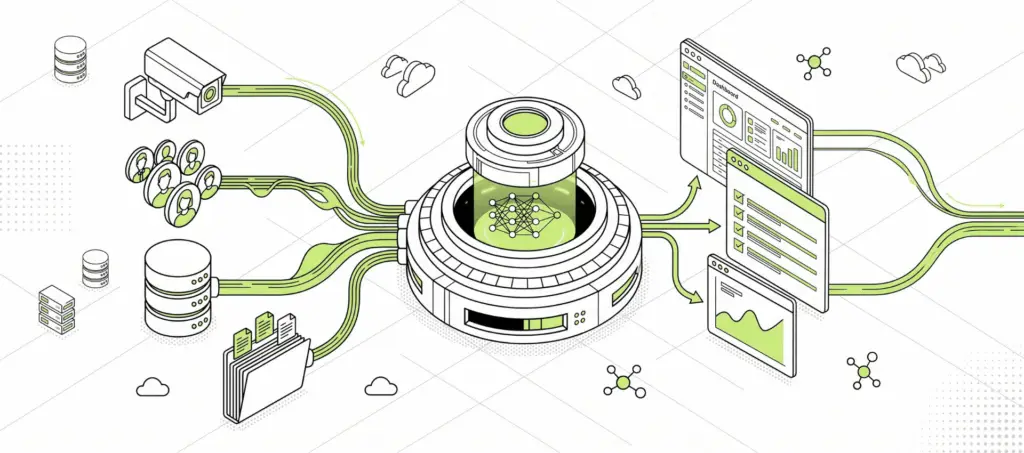
Only what's needed at a given second is fed into the model. Automations operate like sealed pipelines – the model doesn't have "loose" access to the entire computer, email inbox, or database. The system only passes on the specific file or record (one invoice, one feedback) necessary to complete a given task, nothing more.
Credentials and passwords are secured outside the code. We store all access data and API keys encrypted within the automation credential manager or in configuration files, outside the application code itself. There's no risk of production secrets ending up in model memory.
If you require full data residency in the EU, that's also possible. For clients with stringent legal requirements, we can install an on-premises automation system on your physical servers, and route AI queries through clouds like AWS Bedrock or Google Vertex in the European region.
Summary
The question "is AI secure?" only makes sense if we ask: secure in what variant and for what data. Consumer plans and commercial plans are two different worlds in terms of model training and data retention. The automation solutions we design receive exactly the data we provide them with—nothing more. And with customer implementations, you retain full ownership of the infrastructure and data, regardless of whether it's a standard cloud model or an on-premises installation with EU residency. The key is that the AI solution can be designed with the level of security you actually need.
If you are wondering what this looks like in your specific case – with your ERP system, email inbox or quotation process – please contact us.